Today, learning has become easier than ever.
You can find thousands of courses online.
Complete a course.
Watch a few videos.
Take a quiz.
And receive a certificate.
Many students collect certificates from multiple platforms and believe they are becoming job-ready.
But there is one important question:
Can a certificate prove that you can actually build software?
Not always.
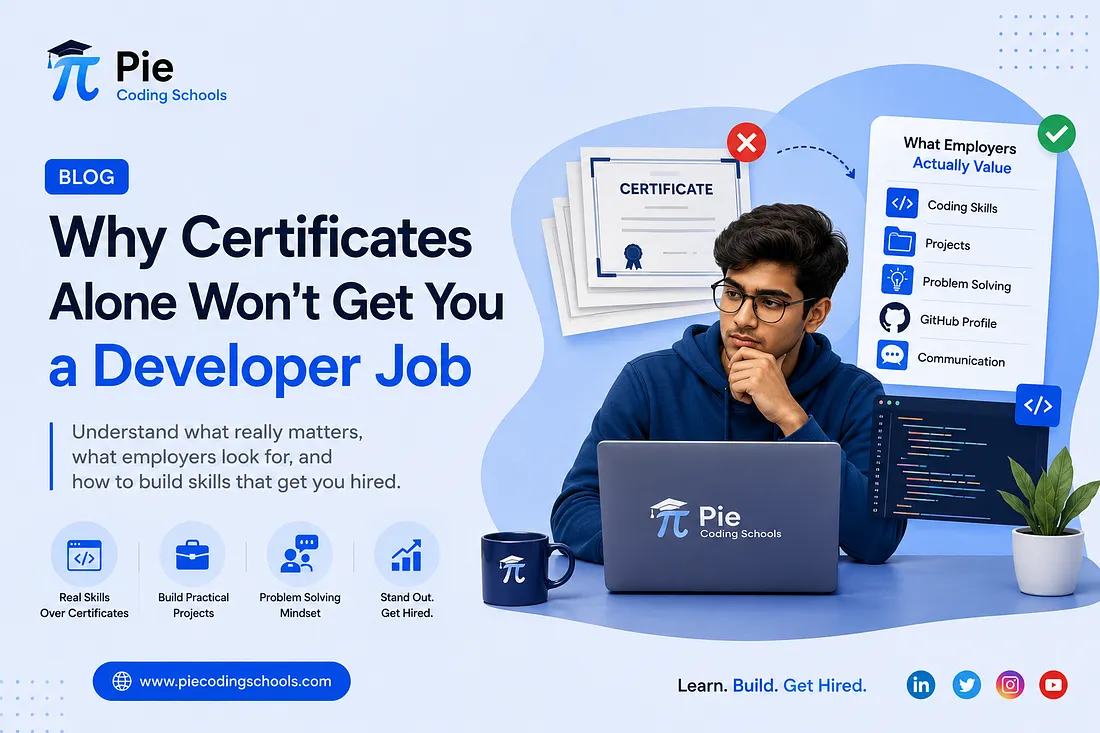
Certificates can show that you completed a course. But companies usually want something more important: proof of your actual skills.
The Certificate Collection Problem
Many students follow the same pattern:
- Complete a Python course
- Get a certificate
- Complete a Java course
- Get another certificate
- Complete a Web Development course
- Get another certificate
- Complete an AI course
- Get another certificate
After one year, they may have 20 certificates.
But then an interviewer asks:
“Can you show me something you have built?”
And suddenly, there is nothing to show.
This is the difference between completing courses and developing skills.
Companies Don't Hire Certificates. They Hire Skills.
Imagine two students applying for the same developer position.
Student A:
- 15 programming certificates
- No GitHub projects
- No portfolio
- Limited practical experience
Student B:
- 3 good projects
- Active GitHub profile
- Can explain their code
- Understands APIs and databases
- Has fewer certificates
Who do you think will have a stronger chance?
In many cases, Student B.
Because projects demonstrate something certificates cannot:
Your ability to apply what you have learned.
What a Certificate Actually Means
Certificates are not useless.
They can show:
- You completed a course
- You learned a particular topic
- You invested time in education
- You are interested in continuous learning
But a certificate usually cannot prove:
- You can solve real problems
- You can build a complete application
- You can debug complex issues
- You can work with a team
- You understand production-level development
- You can explain your technical decisions
That is why certificates should be treated as supporting evidence, not the main foundation of your career.
The Real Question Interviewers Ask
During a technical interview, companies rarely ask:
“How many certificates do you have?”
Instead, they may ask:
- Tell me about a project you built.
- What problem does your project solve?
- What technologies did you use?
- What challenges did you face?
- How did you solve those problems?
- How does your database work?
- How did you design your API?
- Can you explain this code?
These questions test practical understanding.
And practical understanding cannot be developed by only watching tutorials.
Watching Isn't the Same as Building
One of the biggest mistakes students make is confusing watching with learning.
You watch a 10-hour React tutorial.
You understand everything while watching.
The instructor builds an amazing application.
It feels like you learned React.
But the real test begins when you close the video and try to build something on your own.
Suddenly, questions appear:
- How do I start the project?
- How should I structure my components?
- How do I connect the backend?
- Why is this API returning an error?
- Why isn't my state updating?
- How do I deploy this application?
This is where real learning happens.
Building teaches you things that tutorials cannot.
Projects Are Proof of Your Skills
A certificate says:
“I completed a course.”
A project says:
“I can build something.”
That difference is extremely important.
When you build projects, you demonstrate:
- Programming skills
- Problem-solving ability
- Technical understanding
- Debugging skills
- Creativity
- Consistency
- Ability to learn independently
Even a simple project can become valuable if you understand every part of it.
Build Projects Instead of Collecting Certificates
Instead of completing 10 different courses, try this approach:
Step 1: Learn one technology properly.
Step 2: Practice the concepts.
Step 3: Build a small project.
Step 4: Upload it to GitHub.
Step 5: Improve the project.
Step 6: Build something bigger.
For example:
If you learn HTML and CSS:
- Build a portfolio website
- Build a landing page
- Build a product page
If you learn JavaScript:
- Build a calculator
- Build a weather application
- Build a task manager
If you learn Full Stack Development:
- Build an authentication system
- Build an e-commerce application
- Build a student management system
- Build a real-world API
This approach creates both knowledge and experience.
Your GitHub Profile Matters More Than You Think
For a developer, GitHub can become your public portfolio.
A strong GitHub profile can show:
- What projects you have built
- What technologies you use
- How you organize your code
- How consistently you practice
- Your ability to work with version control
You don't need hundreds of repositories.
Even 4–6 well-built projects can create a strong impression.
Focus on quality, not quantity.
Skills + Certificates Is Better Than Certificates Alone
This doesn't mean you should completely ignore certificates.
The best approach is:
Skills + Projects + GitHub + Certificates
Certificates can support your profile.
Projects can demonstrate your skills.
GitHub can showcase your work.
Your knowledge helps you perform in interviews.
All of these things work together.
Common Mistakes Students Make
Many students make these mistakes:
- Completing courses without practicing.
- Collecting certificates instead of building projects.
- Copying tutorial projects without understanding the code.
- Learning multiple technologies at the same time.
- Ignoring Git and GitHub.
- Not creating a portfolio.
- Waiting until final year to start building projects.
Avoid these mistakes.
Start small, but start building.
What Should You Focus On Instead?
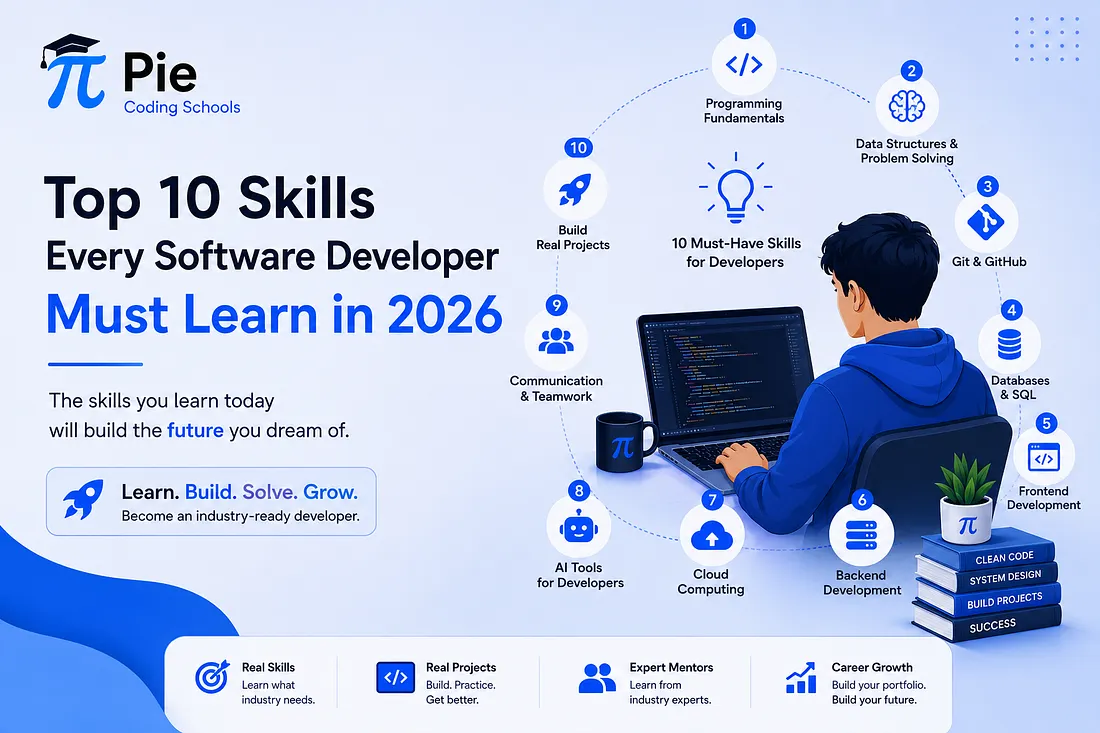
If your goal is to become a software developer, focus on these areas:
- Strong programming fundamentals
- Problem-solving skills
- Data Structures and Algorithms
- Real-world projects
- Git and GitHub
- Databases
- APIs
- Communication skills
- Continuous learning
These skills will help you much more than simply collecting another certificate.
The Reality of the Tech Industry
The technology industry is competitive.
Thousands of students may know the same programming language.
Thousands may complete the same online course.
Thousands may have similar certificates.
So how do you stand out?
You build.
You solve problems.
You create projects.
You learn how real software works.
You develop skills that others can actually see.
Certificates are easy to collect. Skills take time to build.
And that is exactly why skills are more valuable.
At Pie Coding Schools, We Focus on Building
At Pie Coding Schools, we believe learning should go beyond completing videos and collecting certificates.
Students should:
- Write code
- Build projects
- Make mistakes
- Debug problems
- Use GitHub
- Understand real development workflows
- Learn from practical experience
The goal isn't simply to finish a course.
The goal is to develop skills that help you build real products and prepare for real opportunities.
Final Thoughts
Certificates are not bad.
But certificates alone are not enough.
Don't measure your progress by the number of certificates you collect.
Measure it by:
- What you can build
- What problems you can solve
- What you understand
- How much you have improved
A single well-built project can sometimes teach you more than several completed courses.
So the next time you finish a course, don't immediately search for another certificate.
Open your code editor.
Build something.
Break something.
Fix it.
Upload it to GitHub.
That's how developers grow.
Learn Skills. Build Projects. Create Opportunities.