Every year, thousands of students graduate with degrees in Computer Science, BCA, B.Tech, MCA, and other technical fields.
They learn programming languages.
Complete online courses.
Collect certificates.
Prepare resumes.
But when it is time to apply for jobs, one question creates confusion:
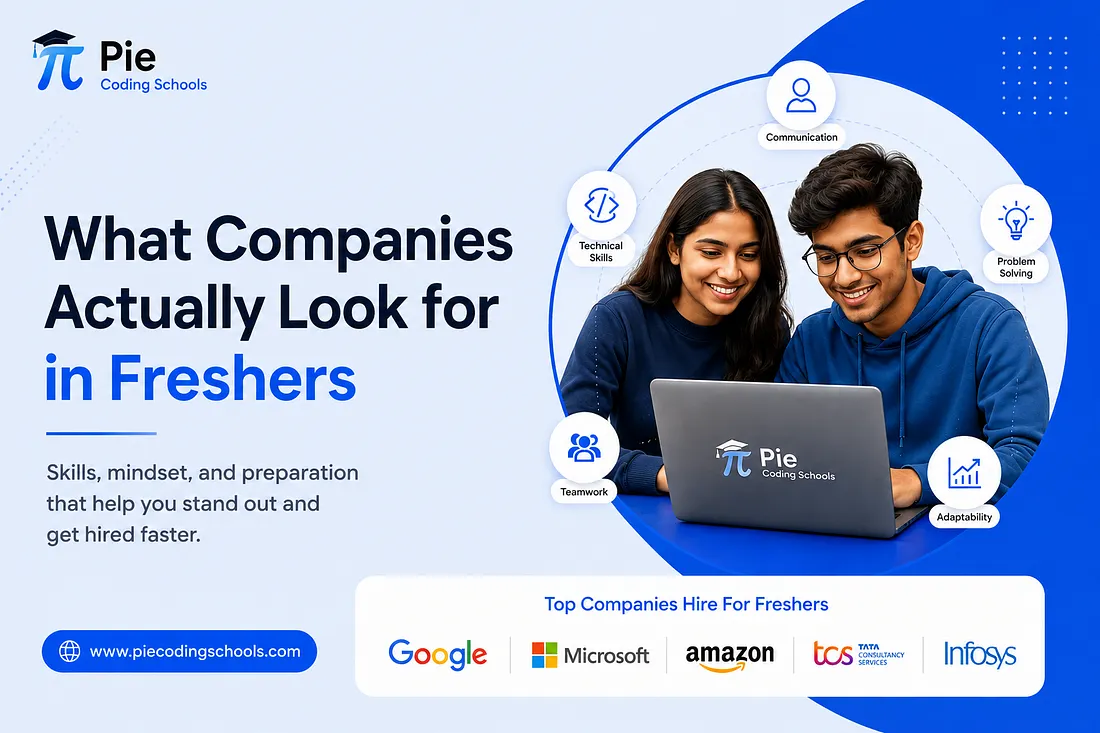
What do companies actually look for in freshers?
Do you need to know every programming language?
Do you need to solve 1,000 DSA problems?
Do you need to become a Full Stack Developer, DevOps Engineer, and Cybersecurity Expert at the same time?
The answer is no.
Companies do not expect freshers to know everything.
What they look for is much more practical.
They want people who have strong fundamentals, can solve problems, have built something, communicate clearly, and are willing to learn.
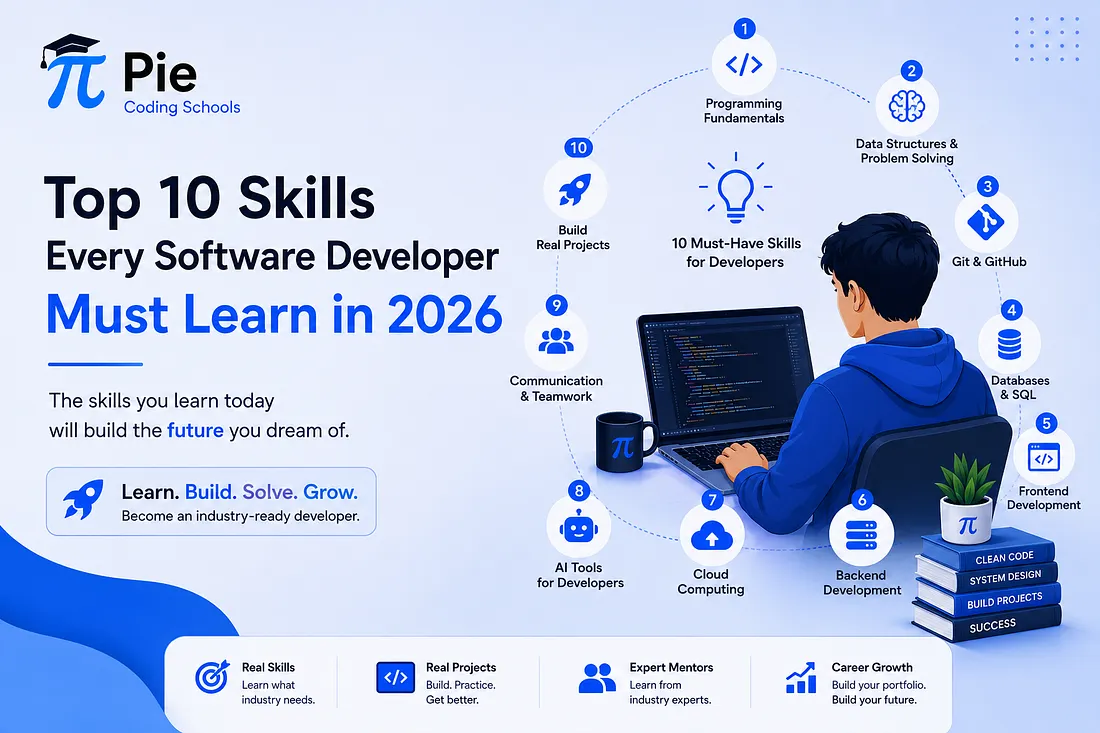
1. Strong Programming Fundamentals
Everything starts with programming fundamentals.
You may know React, Spring Boot, Node.js, or any modern framework.
But if your programming fundamentals are weak, you will eventually struggle.
Companies expect freshers to understand the basics of programming properly.
This includes:
- Variables and Data Types
- Conditions
- Loops
- Functions
- Arrays and Strings
- Object-Oriented Programming
- Basic Memory Concepts
- Error Handling
- Debugging
The programming language is less important than your understanding of programming logic.
Whether you choose Java, Python, JavaScript, C++, or another language, make sure you understand it properly.
Knowing one language deeply is better than knowing five languages only at a basic level.
2. Problem-Solving and DSA Skills
Writing syntax is one thing.
Solving problems is another.
This is why Data Structures and Algorithms are important for software developers.
Companies want to understand how you think when you face a problem.
You should practice topics such as:
- Arrays
- Strings
- Linked Lists
- Stacks
- Queues
- Hashing
- Recursion
- Sorting
- Searching
- Trees
- Basic Graphs
You do not need to become a competitive programming expert to get your first job.
But you should be able to:
- Understand a problem
- Break it into smaller parts
- Think about different solutions
- Write logical code
- Understand time complexity at a basic level
DSA becomes especially important for software engineering and product-based company interviews.
For development-focused roles, companies may place more emphasis on practical development skills and projects.
The best approach is to balance both.
Learn to solve problems, not just memorize solutions.
3. Real Development Skills
One of the biggest differences between a student and a job-ready developer is the ability to build real applications.
Companies want freshers who understand how software works beyond individual programming problems.
For example, a modern web application usually involves:
- Frontend
- Backend
- APIs
- Databases
- Authentication
- Deployment
You don't need to master every technology.
But you should become strong in at least one development area.
For example:
Frontend Development:
- HTML
- CSS
- JavaScript
- React.js
- Next.js
Backend Development:
- Node.js
- Express.js
- Java Spring Boot
- REST APIs
- Authentication
Database Skills:
- MySQL
- PostgreSQL
- MongoDB
- Database Design
The goal is not to learn everything.
The goal is to understand one technical stack well enough to build something useful.
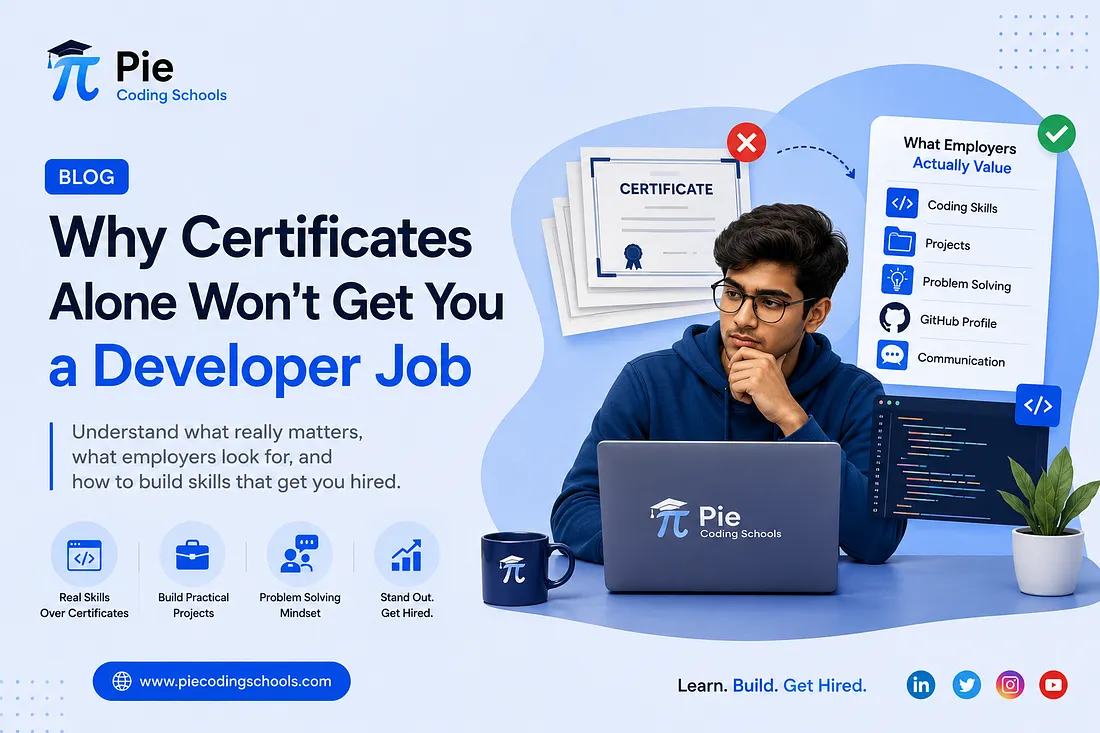
4. Real Projects That Demonstrate Your Skills
This is one of the most important things companies look for.
A resume can say:
“I know React.”
But a project can prove it.
A resume can say:
“I know Node.js.”
But a working API can prove it.
Projects demonstrate your ability to apply your knowledge.
Good projects can show:
- Technical skills
- Problem-solving ability
- Database knowledge
- API development
- Authentication
- UI development
- Debugging ability
- Deployment knowledge
Companies may ask questions such as:
- What problem does your project solve?
- Why did you choose this technology?
- What was the most difficult problem?
- How does your database work?
- How does authentication work?
- What would you improve if you had more time?
That is why you should never blindly copy a project.
Build something you understand.
One well-built project that you can explain is more valuable than ten copied projects.
5. Git and GitHub Knowledge
Git is not an optional skill for modern developers.
Almost every professional development team uses version control.
As a fresher, you should understand:
- Git repositories
- git add
- git commit
- git push
- Branches
- Merging
- Pull Requests
- Basic merge conflicts
GitHub is also useful for showcasing your work.
Your GitHub profile can demonstrate:
- Your projects
- Your coding activity
- Your code quality
- Your project documentation
- Your understanding of collaboration
You don't need 100 repositories.
Focus on a few high-quality projects with:
- Clean code
- Meaningful commits
- Proper README files
- Clear project descriptions
Your GitHub can become your public developer portfolio.
6. Basic DevOps and Deployment Knowledge
Freshers do not need to become DevOps engineers.
But understanding how software moves from your laptop to the internet can give you a major advantage.
Many students can build an application locally.
But when someone asks:
“Can you deploy it?”
They don't know what to do next.
That is why developers should understand basic deployment concepts.
Learn about:
- Deployment
- Environment Variables
- Docker Basics
- Linux Basics
- CI/CD Basics
- Cloud Computing Basics
You don't need deep expertise in AWS, Kubernetes, or advanced DevOps systems as a fresher.
But understanding the software lifecycle will make you a stronger developer.
For example:
Write Code → Test → Push to GitHub → Build → Deploy → Monitor
Understanding this workflow is extremely useful in real-world development.
7. Basic Security Awareness
Every developer should understand basic security concepts.
You do not need to become a cybersecurity professional.
But developers are responsible for writing secure applications.
At a basic level, you should understand:
- Authentication vs Authorization
- Password Hashing
- JWT Basics
- SQL Injection
- XSS Attacks
- Environment Variables
- API Security
- Protecting Sensitive Data
Security awareness helps developers avoid common mistakes.
For example:
- Never store passwords as plain text.
- Never expose secret API keys publicly.
- Validate user input.
- Protect sensitive API routes.
You don't need to master cybersecurity.
But understanding security basics makes you a more responsible developer.
8. Communication and Teamwork
Many students underestimate communication skills.
They believe:
“I am a developer. I only need to write code.”
But software development is a team activity.
Developers work with:
- Other Developers
- Designers
- Product Managers
- QA Engineers
- Clients
- Business Teams
Companies want people who can communicate clearly.
You should be able to:
- Explain your project
- Explain your code
- Ask good questions
- Understand requirements
- Give updates to your team
- Accept feedback
- Work with others
You don't need perfect English.
You need clear communication.
During an interview, a technically strong candidate can still struggle if they cannot explain what they built.
Practice talking about your projects, not just building them.
9. Learning Ability and Adaptability
Technology changes constantly.
The framework you learn today may change in a few years.
New tools appear every year.
AI is changing how developers write and review code.
Companies understand that freshers don't know everything.
What they want to know is:
Can this person learn?
A good fresher should be:
- Curious
- Open to feedback
- Willing to learn new technologies
- Comfortable making mistakes
- Capable of finding solutions
- Not afraid to ask questions
Sometimes the best answer during an interview is:
“I haven't worked with this technology yet, but I understand the basics and I am confident I can learn it.”
Honesty and learning ability are much better than pretending to know everything.
10. Professional Attitude and Consistency
Technical skills are important.
But attitude also matters.
Companies want freshers who are:
- Responsible
- Consistent
- Professional
- Open to feedback
- Willing to improve
- Reliable
No fresher knows everything.
Companies know that.
But they want to hire people who can grow into strong professionals.
Your attitude during interviews and teamwork can make a big difference.
What Companies Don't Expect From Freshers
Let's remove one major misconception.
Companies do not expect every fresher to know:
- 10 Programming Languages
- Advanced System Design
- Expert-Level DevOps
- Advanced Cybersecurity
- Every Cloud Platform
- Every Framework
Trying to learn everything at once usually creates confusion.
Instead, build a strong foundation.
Then choose a direction.
For example:
Programming Fundamentals
↓
Problem Solving & DSA
↓
Choose a Development Path
↓
Build Projects
↓
Learn Git & Deployment
↓
Understand Basic Security
↓
Keep Learning
This approach is much more effective than randomly learning technologies.
The Biggest Mistake Freshers Make
The biggest mistake is trying to prepare for everything.
Students often think:
“I need Java.”
“I also need Python.”
“I need React.”
“I need AI.”
“I need DevOps.”
“I need Cybersecurity.”
“I need Cloud.”
Then they start learning everything.
And master nothing.
A better approach is:
- Learn programming fundamentals.
- Practice problem-solving.
- Learn one development stack.
- Build real projects.
- Learn Git and GitHub.
- Understand deployment.
- Learn security basics.
- Continue improving.
Depth is more valuable than superficial knowledge of many technologies.
How to Become More Employable as a Fresher
If you are preparing for your first developer job, focus on building this profile:
Technical Foundation
- One Programming Language
- Programming Fundamentals
- Basic DSA and Problem Solving
Development Skills
- One Technical Stack
- Databases
- APIs
- Authentication
Practical Experience
- 3–4 Good Projects
- GitHub Profile
- Portfolio
- Deployment Experience
Professional Skills
- Communication
- Teamwork
- Learning Ability
- Consistency
This combination can make you much more prepared than simply completing multiple courses and collecting certificates.
At Pie Coding Schools, We Focus on Industry-Ready Skills
At Pie Coding Schools, we believe students should understand how real software is built.
Learning should not stop at:
Watching videos.
Completing assignments.
Collecting certificates.
Students should also:
- Write code
- Solve problems
- Build projects
- Use GitHub
- Work with APIs and databases
- Understand deployment
- Learn real development workflows
The goal isn't to make students memorize technologies.
The goal is to help them develop the ability to learn, build, solve problems, and adapt to the technology industry.
Final Thoughts
Companies don't expect freshers to be experts.
They know you are at the beginning of your career.
But they want to see potential.
They want evidence that you can:
- Learn
- Think
- Solve problems
- Build something
- Work with others
- Improve continuously
Focus on becoming a strong developer, not just someone with a long list of technologies on their resume.
Learn the fundamentals.
Practice problem-solving.
Build real projects.
Understand how software works.
Keep learning.
That is what makes a fresher valuable.
Remember:
Companies don't hire freshers because they know everything.
They hire freshers who show the potential to learn, build, and grow.
Learn Skills. Build Projects. Create Opportunities.