For millions of students in India, there is one belief that has been passed from generation to generation:
Get a good degree, and you will get a good job.
For many years, this formula worked.
Complete school.
Get admission into college.
Earn a degree.
Attend campus placements.
Start your career.
But the technology industry has changed.
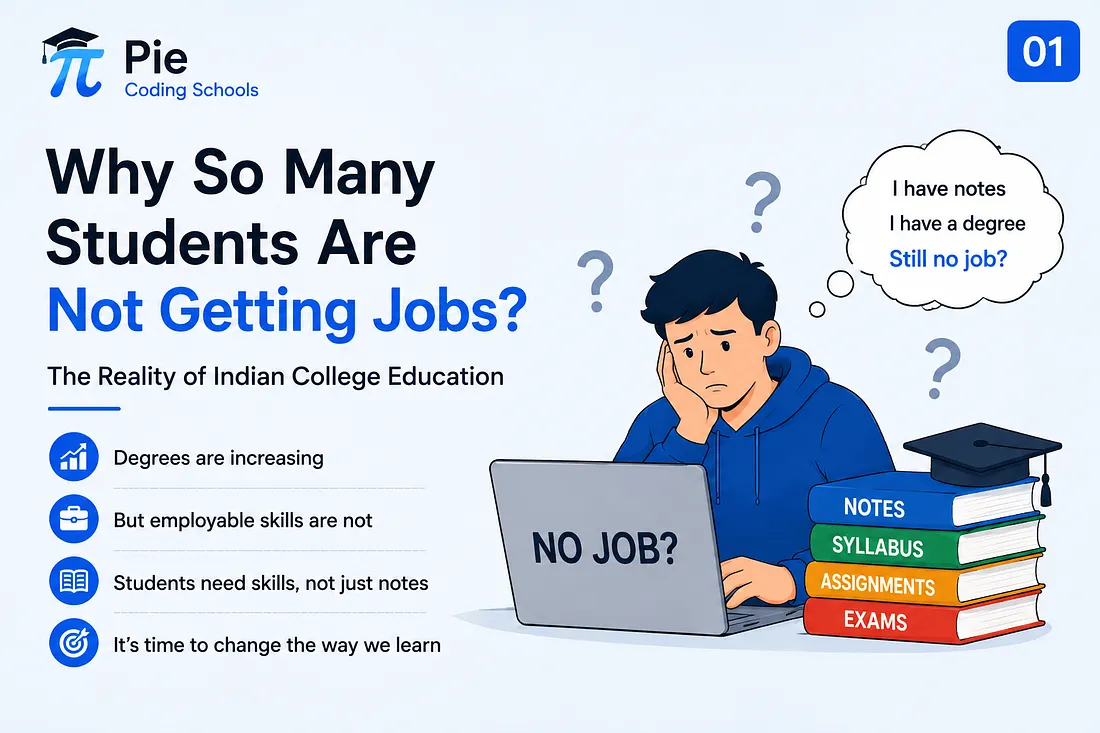
Today, thousands of students graduate every year with B.Tech, BCA, MCA, B.Sc Computer Science, and other technical degrees.
Yet many of them still struggle to get their first job.
This creates an important question:
If so many students have degrees, why are so many still struggling to find opportunities?
The answer is not that degrees are useless.
The answer is that a degree alone is no longer enough.
In today's technology industry, companies increasingly want something beyond academic qualifications.
They want skills.
They want problem-solving ability.
They want projects.
They want practical knowledge.
They want people who can learn and adapt.
So let's answer the real question:
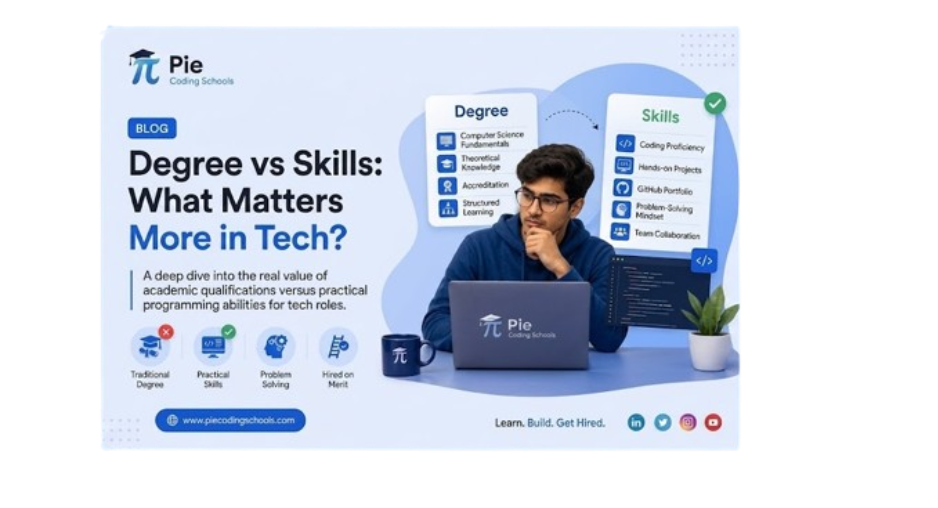
Degree vs Skills: What actually matters more in tech?
The Short Answer: You Need Both
This is not really a battle between degree and skills.
The strongest combination is:
Degree + Skills + Projects + Experience + Continuous Learning
A degree can give you opportunities.
Skills help you perform when those opportunities arrive.
A degree may help you get shortlisted.
Your skills help you clear the interview.
A degree can provide a foundation.
Practical experience teaches you how the real world works.
So the real problem is not choosing between degree and skills.
The real problem is graduating with a degree but without developing useful skills alongside it.
The Reality of Indian College Students
Let's talk honestly about what happens in many Indian colleges.
A student enters college with excitement.
They want to become a software developer.
They imagine building applications, working at technology companies, and creating innovative products.
But slowly, the college routine begins.
Classes.
Attendance.
Assignments.
Internal exams.
Practical files.
Semester exams.
Notes.
Marks.
Then the cycle repeats.
Year after year.
Many students become experts at passing exams.
But they never get enough opportunities to build something real.
They may know the definition of a programming language.
But they may struggle to create a complete application.
They may know the theory of databases.
But they may never design a real database.
They may study software engineering.
But they may never work on software with a team.
They may learn about web development.
But they may never deploy a website.
This is where the gap begins.
The Exam System vs The Real Technology Industry
College and industry often measure students differently.
In college, students are often evaluated by:
- Marks
- Assignments
- Written exams
- Theory knowledge
- Attendance
In the technology industry, developers are evaluated by:
- Problem-solving ability
- Technical skills
- Projects
- Communication
- Teamwork
- Ability to learn
- Ability to build and debug software
These are two very different environments.
A student can score excellent marks in college and still struggle in a technical interview.
At the same time, a student with average marks can become an excellent developer if they consistently build skills and projects.
This doesn't mean marks don't matter.
It means marks are only one part of the picture.
What Happens During College?
Many students spend their first few years doing exactly what the system tells them to do.
Attend classes.
Complete assignments.
Prepare notes.
Pass exams.
Move to the next semester.
The problem is that nobody clearly explains what happens after graduation.
Students often realize this too late.
In the final year, suddenly everyone starts asking:
“How do I get a job?”
“What should I learn?”
“What projects should I build?”
“What is DSA?”
“How do I use GitHub?”
“How do I prepare for interviews?”
“Which programming language should I learn?”
By this time, the pressure becomes much higher.
Students try to learn everything in a few months.
Java.
Python.
React.
AI.
Machine Learning.
DSA.
Cloud.
DevOps.
Cybersecurity.
And in the process, they often become confused.
The problem isn't that students don't want to learn.
The problem is that many students don't have a clear roadmap connecting college education with industry requirements.
A Degree Is Not Useless
Let's make one thing very clear.
A degree still has value.
It can provide:
- Educational foundations
- Access to campus placements
- Eligibility for many jobs
- Networking opportunities
- Exposure to different subjects
- Higher education opportunities
Many companies still require a bachelor's degree for certain roles.
A degree can also help during the initial screening process.
So saying:
“Degrees are completely useless.”
Would be wrong.
But saying:
“A degree alone guarantees a job.”
Is also no longer true.
The modern reality is somewhere in the middle.
A degree can open the door. Skills determine what you can do after entering.
Why Skills Matter More Than Ever
Technology changes quickly.
A university curriculum may take years to update.
But the technology industry changes much faster.
New frameworks appear.
AI tools evolve.
Cloud platforms grow.
Security requirements change.
Development practices improve.
This means students cannot depend only on their college syllabus.
They need to become independent learners.
Companies don't just want someone who completed a syllabus.
They want someone who can:
- Learn new technologies
- Solve unfamiliar problems
- Read documentation
- Debug issues
- Work with a team
- Build real solutions
These abilities come from practice.
And practice creates skills.
Two Students, Same Degree, Different Results
Imagine two B.Tech Computer Science students.
Both graduate from college in the same year.
Both have the same degree.
But their journeys are different.
Student A:
- Attended college regularly
- Passed all semester exams
- Collected certificates
- Completed assignments
- Focused mainly on marks
- Has little practical experience
- No serious projects
- Weak GitHub profile
Student B:
- Completed college requirements
- Learned programming outside the syllabus
- Practiced DSA and problem-solving
- Built multiple projects
- Used Git and GitHub
- Learned APIs and databases
- Deployed applications
- Participated in internships or practical programs
Both students have the same degree.
But their profiles are completely different.
This is why the degree itself is not enough to differentiate candidates anymore.
Skills create differentiation.
What Companies Actually Need
Companies don't hire freshers because they have completed a syllabus.
Companies hire people to solve problems.
A software company needs developers who can:
- Understand requirements
- Write clean code
- Build features
- Fix bugs
- Work with APIs
- Understand databases
- Collaborate with a team
- Learn new technologies
That is why companies often evaluate candidates through:
- Coding rounds
- Technical interviews
- Project discussions
- Problem-solving questions
- Communication rounds
- Practical assignments
Notice something important.
These processes usually test what you can do.
Not just what degree you have.
Skills Companies Value in Technology Roles
The exact requirements depend on the role, but strong technology candidates usually develop a combination of technical and professional skills.
Programming Fundamentals:
- Variables and Data Types
- Functions
- Loops
- Arrays and Strings
- Object-Oriented Programming
- Debugging
Problem-Solving and DSA:
- Arrays
- Strings
- Linked Lists
- Stacks and Queues
- Hashing
- Recursion
- Sorting and Searching
- Basic Trees and Graphs
Development Skills:
- Frontend or Backend Development
- APIs
- Databases
- Authentication
- Real-world application development
Modern Engineering Skills:
- Git and GitHub
- Deployment Basics
- Cloud Fundamentals
- Docker Basics
- CI/CD Awareness
- Basic Security Awareness
Professional Skills:
- Communication
- Teamwork
- Critical Thinking
- Learning Ability
- Adaptability
You don't need to master everything at once.
But developing these skills gradually can make you much more prepared for the industry.
The Biggest Problem: Students Learn Only for Exams
This is one of the biggest challenges.
Students often ask:
“Is this important for the exam?”
Instead of asking:
“Is this important for my career?”
That mindset creates a major difference.
Exam-focused learning usually ends after the exam.
Career-focused learning continues.
For example:
You learn C programming for an exam.
After the exam, you forget it.
Or you learn C programming to understand:
- Programming logic
- Memory
- Pointers
- Problem-solving
Now the knowledge becomes useful beyond the exam.
The same concept applies to every subject.
Don't only study to pass.
Study to understand.
Practice to build skills.
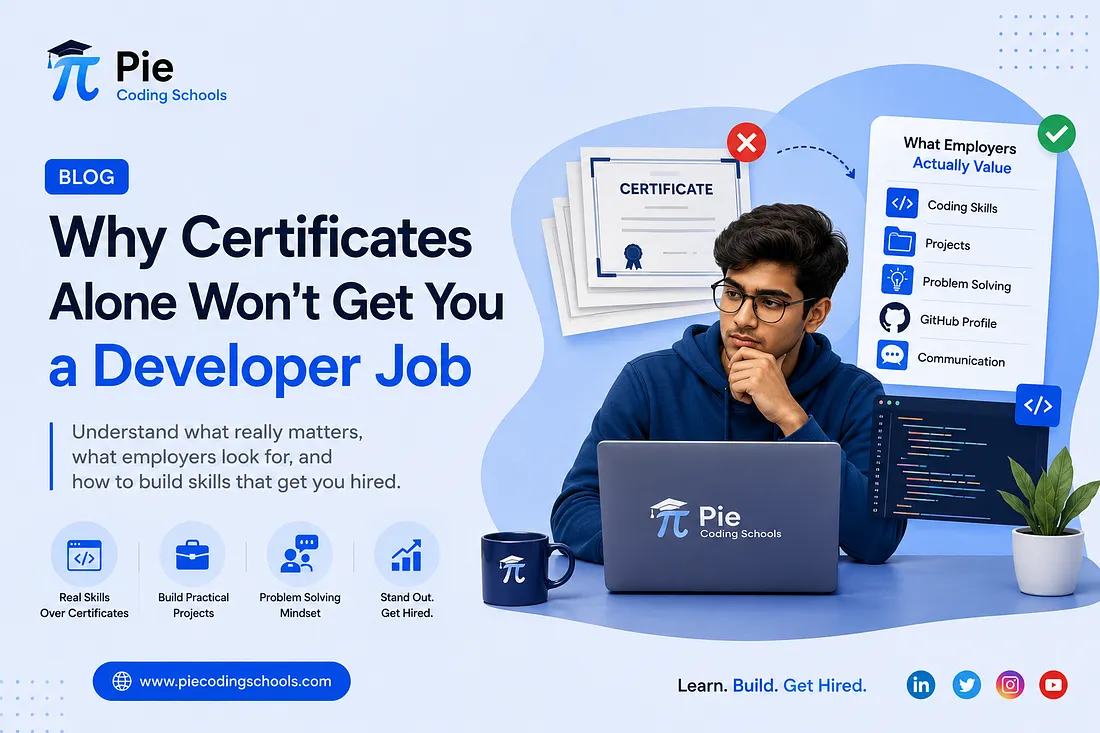
Certificates, Marks, and Degrees Are Not Proof of Practical Ability
A student can have:
- A good degree
- High marks
- Multiple certificates
And still struggle to build a real application.
Why?
Because knowledge and application are different things.
You can watch someone build an application.
That doesn't mean you can build it yourself.
You can read about databases.
That doesn't mean you can design one.
You can complete a React course.
That doesn't mean you can independently build a production-style application.
Real learning happens when you:
Try something.
Make mistakes.
Get errors.
Search for solutions.
Read documentation.
Debug the problem.
Fix it.
That process creates developers.
Why Projects Matter So Much
A project connects theory with reality.
Suppose you build a student management system.
Suddenly, you need to think about:
- User Interface
- Backend Logic
- Database Design
- Authentication
- APIs
- Error Handling
- Deployment
Now you are not simply studying technologies separately.
You are learning how they work together.
This is much closer to how real software development works.
Projects also give you something important during interviews:
Something real to talk about.
You can explain:
- What you built
- Why you built it
- What technologies you used
- What problems you faced
- How you solved them
A project becomes evidence of your skills.
The Indian Student Trap: Waiting Until Final Year
Many students make the same mistake.
They wait.
First year:
“I have plenty of time.”
Second year:
“I'll start next semester.”
Third year:
“Now I should probably learn something.”
Final year:
“Placements are coming. What should I do?”
Then panic begins.
The student tries to learn everything quickly.
This creates stress and confusion.
The better approach is to start early.
First Year:
- Learn programming fundamentals
- Build logical thinking
- Understand how computers and software work
Second Year:
- Learn DSA
- Explore development
- Start using GitHub
- Build small projects
Third Year:
- Choose a technical direction
- Build stronger projects
- Learn databases and APIs
- Explore internships
Final Year:
- Improve your portfolio
- Prepare for interviews
- Apply for internships and jobs
- Strengthen weak areas
Four years is actually a lot of time.
The problem is not always a lack of time.
Often, it is a lack of direction.
Degree vs Skills Is Actually the Wrong Question
Many students ask:
“Should I focus on my degree or skills?”
The better question is:
How can I use my college years to build both?
Your degree gives you a structure.
Your skills give you practical ability.
College gives you time and access to learning.
Personal projects give you experience.
Teachers can teach concepts.
The internet gives you unlimited resources.
GitHub gives you a place to showcase your work.
Today, students have more learning opportunities than any previous generation.
The challenge is not access to information.
The challenge is taking action.
What Should Indian Students Do Differently?
Don't depend completely on your college syllabus.
Use college as your foundation.
Then build additional skills around it.
Here is a better approach:
1. Take Your Degree Seriously
Don't ignore your academics completely.
Understand core subjects and maintain a reasonable academic record.
2. Learn One Programming Language Properly
Don't jump between five languages.
Understand programming deeply.
3. Practice Problem-Solving
Develop logical thinking and learn DSA gradually.
4. Build Projects
Start small and increase complexity over time.
5. Use Git and GitHub
Document your journey and showcase your work.
6. Learn How Real Software Works
Understand APIs, databases, authentication, deployment, and collaboration.
7. Improve Communication
Practice explaining your ideas and projects clearly.
8. Keep Learning
Technology will continue to change throughout your career.
What Makes a Student Industry-Ready?
Industry readiness is not about knowing every technology.
It is about developing the ability to learn and contribute.
A strong fresher profile might look like this:
Foundation
- Strong Programming Fundamentals
- Problem-Solving Ability
- Basic DSA Knowledge
Technical Direction
- One Strong Development Skill
- Databases
- APIs
- Git and GitHub
Practical Experience
- 3–4 Good Projects
- Deployment Experience
- Internship or Real-World Exposure
Professional Growth
- Communication
- Teamwork
- Learning Ability
- Consistency
This is much more valuable than simply having a long list of technologies on your resume.
The Future Belongs to Students Who Can Learn and Build
Artificial Intelligence is changing technology.
Development tools are becoming more powerful.
Some tasks that previously took hours can now be completed faster.
But this does not mean fundamental skills are becoming irrelevant.
In fact, understanding technology is becoming even more important.
AI can generate code.
But you still need to understand:
- What the code does
- Whether it is correct
- Whether it is secure
- How to debug it
- How to integrate it into a larger system
The future will reward developers who combine:
Strong Fundamentals + Practical Skills + AI Tools + Continuous Learning
Students who only depend on a degree may struggle.
Students who only chase random technologies may also struggle.
The strongest students will build a balanced profile.
At Pie Coding Schools, We Believe Education Should Lead to Ability
At Pie Coding Schools, we believe a student should not finish a learning journey with only notes and certificates.
Students should finish with the ability to:
- Write code
- Solve problems
- Build projects
- Use GitHub
- Work with real technologies
- Understand development workflows
- Learn independently
The goal isn't to replace college education.
The goal is to help bridge the gap between education and industry.
A degree gives you knowledge.
Practical learning helps you apply that knowledge.
Together, they can create stronger opportunities.
Final Thoughts: Degree Opens the Door, Skills Build the Career
So, what matters more in tech?
Degree or skills?
The honest answer is:
You should have both.
But if you have to understand the difference:
A degree can help you get noticed.
Skills help you prove yourself.
A degree can help you enter the room.
Skills help you stay and grow.
A degree can provide a foundation.
Projects and practical experience build confidence.
Don't spend four years only preparing for exams.
Use those years to build yourself.
Learn.
Practice.
Build.
Make mistakes.
Improve.
Create something real.
Because when you graduate, the question won't only be:
“What degree do you have?”
It will also be:
“What can you actually do?”
Learn Skills. Build Projects. Create Opportunities.